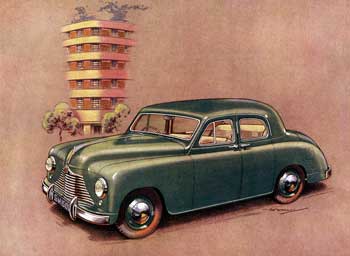
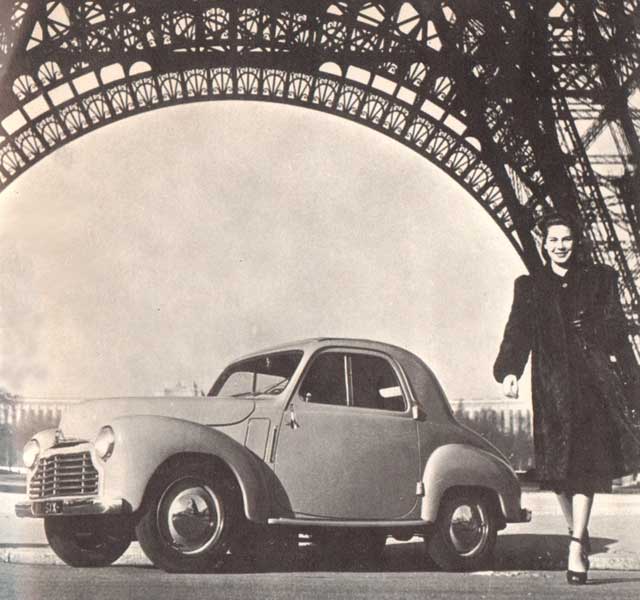
Engine 4 Cylinder 1496 cc Power 52.5 hp @ 4500 rpm Transmission 4 speed manual Chassis Unitary construction Suspension Independent coil spring front, semi-elliptic leaf springs rear Brakes Lockheed hydraulic drum brakes Top speed 80 mph Acceleration Dimensions LxWxH 4.15 x 1.54 x 1.50 m
Data sheet, itself an extract from Saab Sonics no. 21
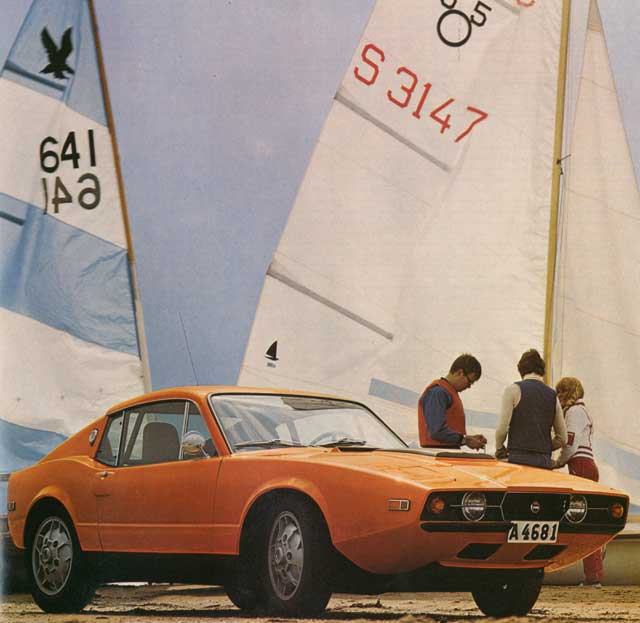
The SAAB SONETT SUPER SPORT
“The greatest sensation at the 1956 Stockholm Motorcar Show (with more than 400 different cars on show) was undoubtedly the Saab Sonett Super Sport, built by Saab’s Motorcar Division at Trolhattan. An experimental car, the Saab Sonett Super Sport has been built mainly to enrichen Saab’s experience in the design of advanced cars. As far as the chassis is concerned, the Saab Sonett is to nearly 100 per cent built on the standard Saab-93 chassis. The car is equipped with a Saab-93 engine, which has been boosted to give 57.5 h.p. at 5.000 r.p.m. (as against 38 h.p. in the standard Saab-93 car). Max. torque is approx. 63 lbs.ft. (9 kpm) at 3,500 r.p.m. By building the Saab Sonett, the motorcar division will get an opportunity to test the Saab-93 engine under exceptional conditions. Another design feature tested in connection with the construction of the new car is the glass fibre laminate (plastics) used in the body of the car. The most interesting design feature is perhaps the box type design used for the mounting of the chassis details. This has been built according to aircraft design principles and is of light metal. Thus, a very low weight of the unit (71 kg.) has been obtained. The work on this car has been directed by Mr. Rolf Mellde, Chief Test Engineer at Saab’s Motorcar Division at Trollhattan. An experimental series of 5 cars is now being built.”
Although some books claim that the car shown at the Stockholm Motor Show remained a one-off, it seems that there are 6 Super Sports still in existance today (thanks to Robert Miller for pointing this out). It was not until the early ’60s that the idea for a sports car was revived. The Sonett II was introduced in 1966. In 1970 it was restyled by Italian Coachbuilder Sergio Coggida and produced as the Sonett III.
The 93 was introduced in December 1955. A 748cc 53hp 3 cylinder engine replaced the original 2 cylinder unit. Coil suspension was used instead of torsion bars. The car had a restyled front.
1957 SAAB 93B
1957 SAAB 93B
NEW SAAB-CAR PUT ON THE MARKET
Ten new features of the 1958 Saab There are many important innovations on the new model of Saab-93 now put on the market. The most striking feature of the Saab-93B, as the new model is called, is the undivided. arched wind-screen enclosed by an elegant metal. In conjunction with the new windscreen, there are improved wind-screen wipers, which have a considerably expanded cleaning surface. A three-position, vertically adjustable back seat is an advancement that many will appreciate. In the highest position even the small children get a good view. Double-acting door stops prevent the doors from closing as passengers enter. The doors also have an American type safety-lock, which keeps them from springing open if the door becomes deformed. Attachments for safety-belts are now standard. Further, the hand brake lever has been raised 10 cm to make it more convenient to reach. Another feature of the car is a self-mixing petrol tank, and in addition it is now possible to reduce the oil admixture in the petrol to 3 % or 1 l. oil to 33 l. petrol. The Saab-93B is also equipped with blinkers.
Source: SAAB Press Release, September 3, 1957.
SAAB 93 B
1957 SAAB 93 B Convenient access to the luggage compartment 🙂 A 45 hp version called the GT750 was introduced in 1958. The station wagon version, the 95, appeared in 1959. The 93B gave way to the 93F which had front-hinged doors and various other improvements
The prototype was first shown to the press on 10 June 1947, but the first pilot production run of 20 cars did not leave the Trollhättan factory gates until Summer 1949.
1949 SAAB 92
The Saab 92 was fitted with a 2-cylinder two-stroke engine based on a DKW design. As might be expected from an aircraft manufacturer, the aerodynamic shape gave the car an extremely low drag coefficient. The 92 had a unitary body construction and front-wheel drive. The only thing really lacking was a boot lid. Access to the luggage compartment was via the back seat. The car was available in one colour only: green. An improved model, the 92B was introduced in Autumn 1952.
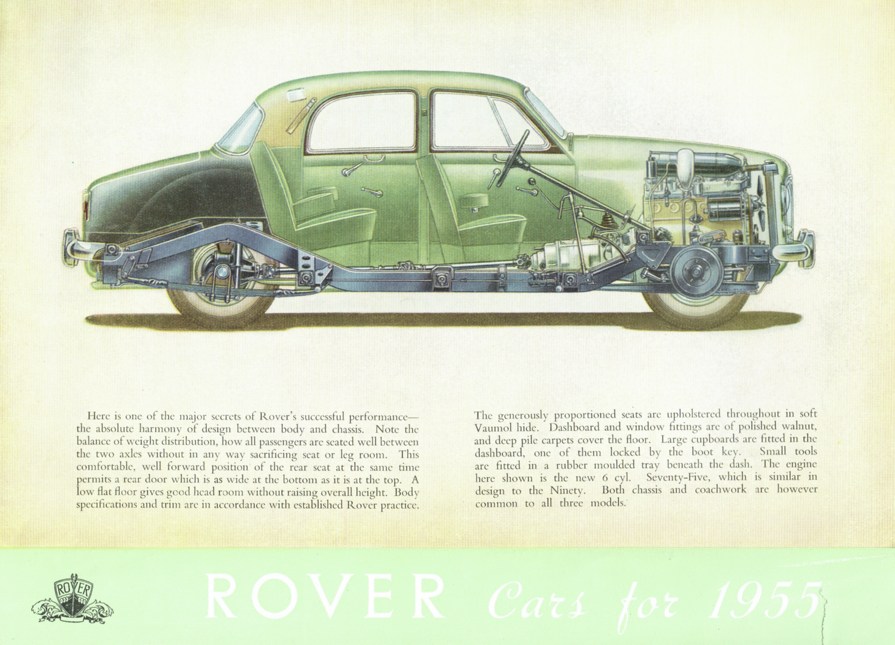
The P4 was based on a design for Studebaker by Raymond Loewy, famous for his streamline shapes. It was announced in the Autumn of 1949. Although the body was completely new, much of the chassis was P3. The P4 75 had the traditional Rover 3-lamp configuration at the front, which earned the car the nickname of Cyclops. The engine was basically the P3 2103 cc six-cylinder in-line unit, but now fitted with an aluminium cylinder head. The P4 model appeared in the course of the years as the 60, 75, 80, 90, 95, 100, 105, 105R, 105S, and 110.
1949 Rover 75 Cyclops
The Cyclops feature was dropped in 1952, mainly as it was found to cause serious cooling problems.
The One-Point-Five was initially intended as the new Morris Minor, but it ended up as the Wolsely 1500 and the Riley 1.5
1958 Riley One-Point Five
1958 Riley One-Point-Five
1958 Riley One-Point Five The engine in the Riley version gave 36 per cent more power than that of the Wolsely, but fewer were sold (39882 Rileys as opposed to 100744 Wolseleys).
Specification (1958 Riley 1.5) Engine Straight 4, 1489cc Power 68 bhp @ 5400 rpm Transmission 4 speed manual Chassis Unitary construction Suspension Independent front and live axle rear Brakes Girling drum Top Speed 140 km/h Acceleration 0-80 km/h: 13 s
When is was introduced, the pathfinder looked thoroughly modern: full-width bodywork with wide, one-piece windscreen.
1954 Riley Pathfinder
1954 Riley Pathfinder
The interior was roomy, with seats for 6. An unsual feature of this car is the position of the gearlever: on the floor, to the right of the driver.
1954 Riley Pathfinder STRICTLY CONFIDENTIAL and NOT FOR PUBLICATION BEFORE WEDNESDAY, 14TH OCTOBER [1954]
THE RILEY PATHFINDER
A Fast, New Sports Saloon
The Riley “Pathfinder”, announced by The Nuffield Organization today is an entirely new and spacious saloon of imaginative body design, having an engine which develops 102 b.h.p. and is capable of a maximum speed, under ideal conditions, of more than 100 m.p.h. In order to achieve higher performance at all speeds the compression ratio of the successful 2443 c.c. o.h.v. engine with hemispherical head has been stepped up to 7.25 to 1. Riley enthusiasts will appreciate the siting of the gear shift lever on the floor on the extreme right-hand side (on the left on l.h.d. cars), a feature which in addition to its comfortable accessibility permits optional use of bucket or bench type seats.
Other refinements include the incorporation of the self-cancelling direction indicator switch on the horn ring, two speed self-parking screen wipers and black lighting for the instrument panel. The body is of all-steel construction with a turret-type top of immense strength. The one-piece curved windscreen and curved rear light give unusual all round visibility and by mounting the 121/2 gallon (59 litres) petrol tank forward of the boot and the spare wheel on a special platform under the boot floor, the amazing luggage capacity of 11 cu.ft, is provided. The boot door is counter-balanced and can thus be raised and lowered without effort. A concealed petrol filler cap with a quick release is provided and the fuel is fed to twin S.U. carburetters by a rear mounted S.U. electric fuel pump of increased capacity. Full width bumpers with over-riders front and rear, and twin tail, stop and reverse lamps are fitted. Rear suspension is by long coil springs with concentrically mounted hydraulic dampers, the axle being located by radius arms and a tranverse link. At the front the successful Riley “Torsionic” independent suspension system of torsion bars controlled by telescopic dampers is incorporated. A Borg and. Beck 10″ single plate dry clutch transmits the power through a four speed, synchromesh gearbox and. Hardy Spicer tubular propeller shaft to the semi-floating hypoid. rear axle of 4.1 to 1 ratio. Servo-assisted. Girling hydraulic fully-compensated brakes operate in 12 inch (30 cm.) drums and individual adjustment is provided, which simultaneously adjusts the handbrakes. The handbrake is of the pistol-grip type located under the facia. Instruments include a revolution indicator and. temperature gauge in addition to the usual equipment. Twin fog lamps, heater, map reading lamp, in-built windscreen washing and demisting equipment are also fitted as standard. The Pathfinder is available in the following colours:- Black (with maroon, green or biscuit upholstery) Maroon (with maroon or biscuit upholstery) Green (with green or biscuit upholstery) Blue (with grey upholstery) Grey (with maroon or grey upholstery)
Specification (Riley Pathfinder 53-57) Engine Straight 4, 2443cc Power 110 bhp @ 4400 rpm Transmission 4 speed manual Chassis Perimeter frame chassis Suspension Torsion bar ifs, live rear Brakes Girling drum, servo-assisted Top Speed 155 km/h Acceleration 0-80 km/h: 11,7 s
A high performance saloon with traditional looks, the car sported a twin-cam engine with hemispherical combustion chambers. The car had a timber-framed body and a fabric covered roof. Fully hydraulic brakes replaced the hydro-mechanical ones in 1952.
1952 Riley 1,5 litre The 2.5 litre model looked identical to the 1.5 , but was 7 inches longer. Roadholding is said to be not quite as good as that of the 1.5 litre.
These handsome Rileys with distinctive fabric roofs were fitted with the pre-war 1.4- and 2.4-litre engines, the larger capacity car being available until 1953. Torsion bar front suspension and high gear rack and pinion steering contributed to good road holding. The cars had well finished interiors. A two door drophead coupé 2.5-litre model also appeared in 1948 but only few were made. RM Rileys have a separate and particularly sturdy chassis.
A restyled model was introduced in 1954 (below). Note the helmet-shaped front wings, built-in fog lamps and lack of running boards
1954 1,5 litre RME RME
1954 RME Press Photo As Riley put it: “Imaginative re-styling brings to the 1.5 litre Riley an enhanced grace, a fresh new beauty, that will captivate all who appreciate the finer points of motor-car design. Skillful streamlining of the wings, faired torpedo-shaped headlamps which merge into the bonnet structure, inset foglamps, plus smart, shapely spats over the rear wheels, all combine to reduce wind resistance still more”.
STRICTLY CONFDENTIAL AND NOT FOR RELEASE BEFORE WEDNESDAY, 14TH OCTOBER [1954]
NEW-LOOK RILEY 1.5 LITRE SALOON
Extensive body restyling, providing greater ease of access, is the outstanding feature of the latest Riley 1 1/2 litre Saloon announced today by The Nuffield Organization. Completely redesigned front and rear wings and the abolition of the running board in favour of sill panels enhance its appearance and afford easier access for the occupants. Spats partially shroud the rear wheels but leave the wheel centres exposed. The side lamps are now faired into the front wings and beneath the re-shaped headlamps are twin fog lamps recessed into the wings as standard fittings. The Riley 1 1/2 litre Saloon retains the well-proved 4-cylinder engine of 1496 c.c. which develops 55 b.h.p. at 4,500 r.p.m. With the coach-built body, the complete design, well-known for its low centre of gravity and Riley “Torsionic” independent front suspension, enables long journeys to be covered effortlessly and in absolute safety. All upholstery is covered in the finest quality leather; a folding centre armrest is fitted to the rear seat and ash trays are readily to hand to drivers and passengers. A full set of instruments, including a water temperature gauge, ammeter and clock, are well grouped in a handsome walnut panel. A heater, with in-built demisting ducts, is fitted as standard.
The home list price of the Riley 11/2 Litre Saloon is;-
List Price: GBP 850. 0. 0
Purchase Tax: GBP355. 5. 10
Total GBP 1,205. 5. 10
Specification (1952 Riley 2.5 Litre)
Engine Twin cam, straight 4, 2443cc Power 101 bhp @ 4500 rpm Transmission 4 speed manual Chassis Chassis + timber-framed body Suspension Independent front and live axle rear Brakes hydro-mechanical drum/hydraulic drum Top Speed 153 km/h Acceleration 0-80 km/h: 18.6 s