Ford Anglia 100E (1954-1959)
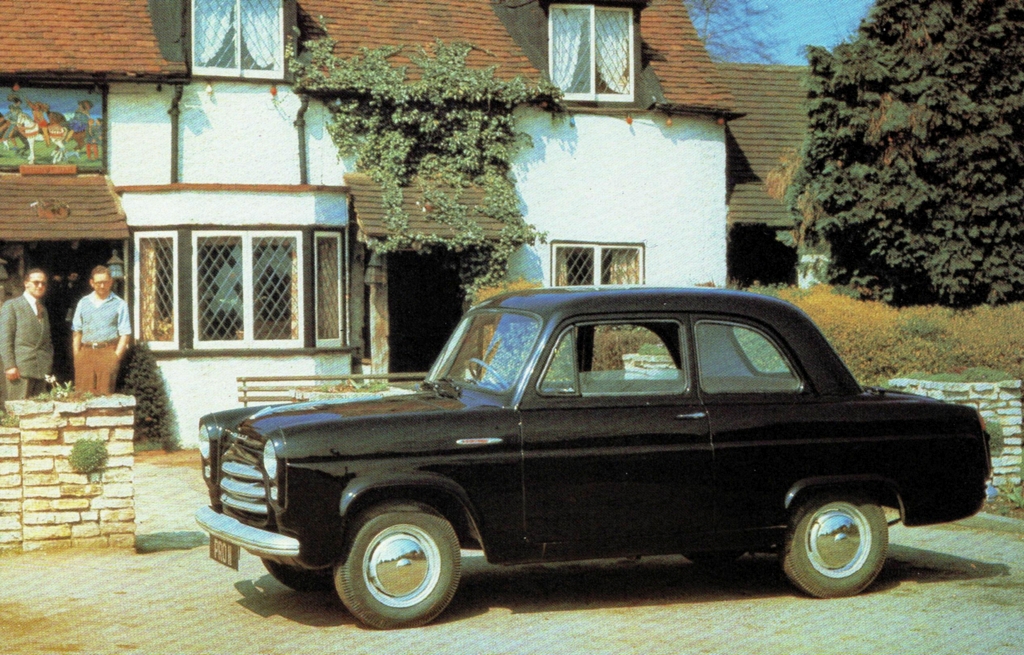
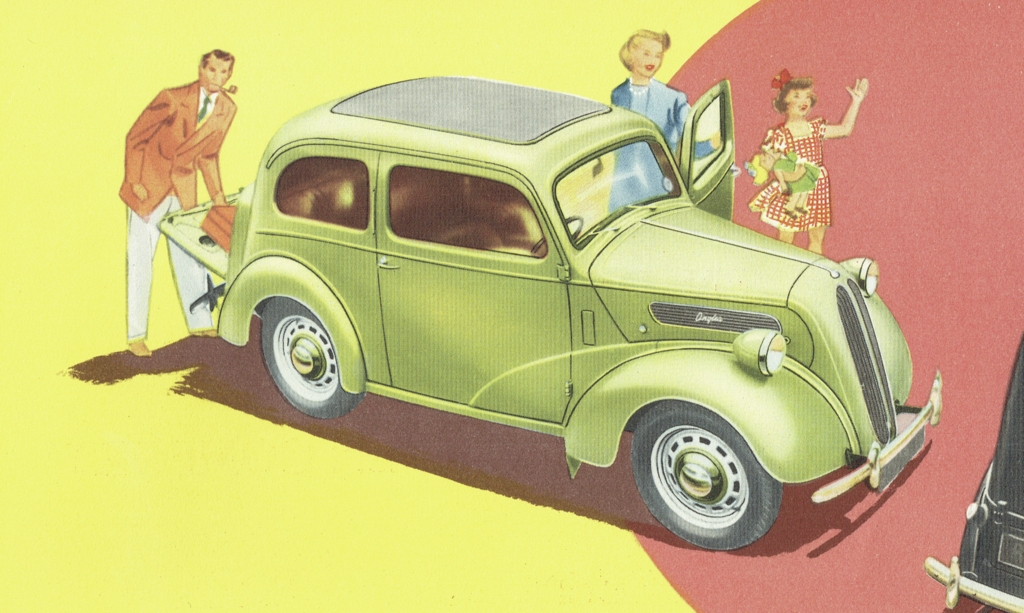
The E494A Anglia was discontinued in 1953, but the body remained as the Ford Popular (aka Ford POP) until 1959.
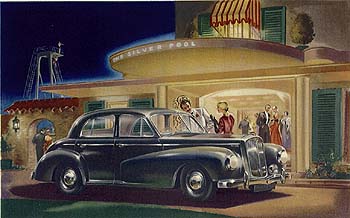
Source: Wolseley brochure
“The first glimpse of the Wolseley Four-Fifty gives an impression of a car of unusual grace and style. Designed and built with meticulous care, no detail affecting the comfort and safety of driver and passengers has been overlooked. The 1.5 litre four-cylinder overhead valve engine, with valves operated direct from the camshaft, develops 50 brake horse power. It will cruise happily at 60 m.p.h. and exceed 70 m.p.h. Long torsion bars and telescopic shock absorbers ensure smooth travel, free from roll. Sparkling new colours are founded on a strong “Monoconstruction” body, rust-proofed throughout for long life and lasting beauty. All upholstery is in leather with Dunlopillo foam rubber cushioning. An air circulating and heating unit is standard. Hydraulic brakes are of the latest type Lockheed with two leading shoes at the front; safety glass is fitted to all windows. The Wolseley Four-Fifty is a full five-seater car.”
Specification 1954 Wolseley 4/50 Engine Straight 4, 1476cc Power 50 bhp @ 4800 rpm Transmission 4 speed manual Chassis Unitary construction Suspension Independent front, semi-elliptic rear Brakes Lockheed drum Top speed 120 km/h Acceleration Dimensions
Volvo PV 800 (1938-1958) Taxicab


Note the ‘winglets’ at the ends of the bumpers.
1946 Volvo PV 444


In 1955 the PV 444 received extensive face-lift treatment, the most obvious being the one-piece rear window and enlarged windscreen. The tail lights were moved from the mudguards to the sides of the car.

VW Beetle Split Rear Window (1938-1953)
KdF Wagen – Kraft durch Freude (strength through joy) was the initial name for the car that would become the Volkswagen (People’s Car).


“Wherever real automobile enthusiasts get together, and whenever the conversation turns to progress in automotive design, the name VW is certain to be mentioned.
Such is the reputation of this car that it has become the criterion of “small car” construction among even the most discriminating buyers of automobiles. A reputation like this had to be earned. Even the 1939 VW model incorporated four years of painstaking development and over 1.5 million miles of actual road tests. The war years served as a Final test. In the guise of a military vehicle the VW did yeoman service under all sorts of going. From the torrid heat of the sandy African deserts to the bitter cold of the snow-covered Russian plains it fulfilled the severest de¬≠mands in a manner unequalled in history.
Today the VW is the leader in the international field of small cars; the masterpiece of the most modern European automobile factory, the most popular of all German cars, not only in the homeland but anywhere in the world.
Well over 100,000 VWs have been built and sold since 1945; indeed a proud record and a well deserved success. They wind their way, fleet, nimble and untiring, through the heavy traffic of the largest cities in the world – a pride and joy to the hundreds of thousands that are so well served every day by them – a pride and joy also to the engineers and more than 10,000 workers who build them.”
Excerpt from the 1949 brochure
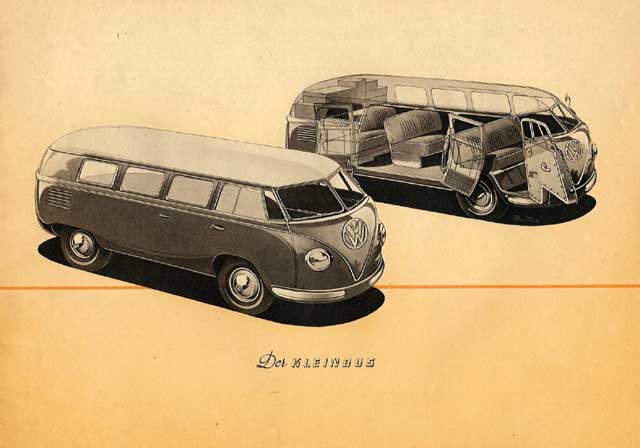
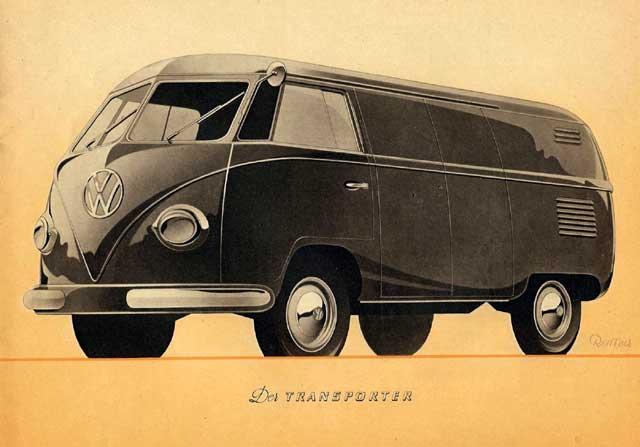
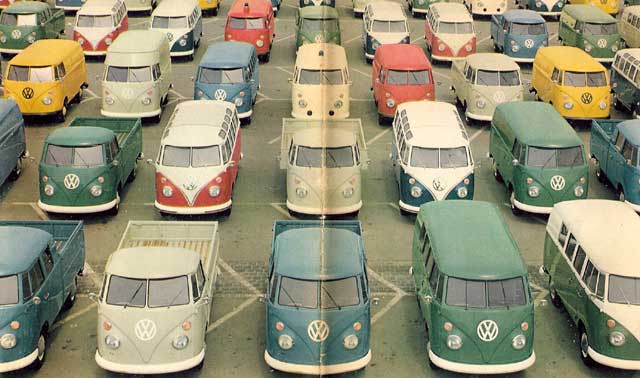
The transporter, bus or Bulli as it is known in Germany, has gained cult status. The Dutch VW importer, Ben Pon, is said to have made the first sketches for the Transporter. There have been 6 generations up to 2021, known as T1 to T6.
VW Transporter
VW Bulli

More illustrations to follow …
The Vauxhall Cresta was from 1954 to 1972. The Cresta was introduced in 1954 as an upmarket version of the Vauxhall Velox, itself a six-cylinder version of the Vauxhall Wyvern. The Cresta models were the E (1954–1957), PA (1957–1962), PB (1962–1965) and PC (1965–1972). The Viscount (1966–1972) was an upmarket Cresta PC.
Vauxhall Cresta

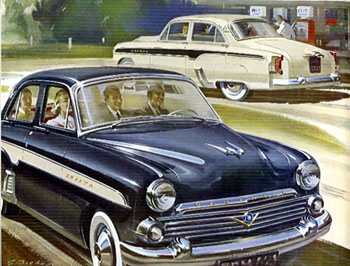
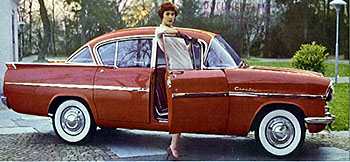
The US-styling of the 1958 Vauxhall Cresta was quite a shock (as were the colour schemes), nevertheless 1958 was a record year for Vauxhall, with 114,117 cars sold.
Words: Vandenplas brochure
Here it is.
The Vanden Plas Princess 4-litre R.
Look at it from the outside first. It repays a good look – Vanden Plas coachwork sees to that.
Vandenplas

Smooth, elegant lines conceal the surging power inside – but more about that later. Notice some of the finer points which go to make up the picture. The front of the car has an attractive, uncluttered appearance: here’s where a car’s personality shows, and the Princess R has the classic look. Wrap-round side and flasher lamps are mounted on the wings and “Fogranger” lamps fit on the side panels of the radiator grille. It is in the careful blending together of individual functional items that good coach design consists. Even the placing of the over-riders is important -and precisely right.
To maintain the overall smoothness of line, the windscreen merges easily and naturally into the roof peak. The whole effect is pleasing to the eye -exactly the intention of the designer. But this is only part of the story. Classic lines and a luxurious appearance are not enough and the Princess R, being the thoroughbred it is, adds grace in movement to its classic look at rest.
This is achieved by superb suspension, giving perfect travelling comfort and road-holding. Independent coil spring front suspension is controlled by lever-type shock absorbers and an anti-roll bar. Trunnion-mounted leaf springs at the rear are stabilised by splayed, telescopic shock absorbers.
Safe, comfortable travel at high speeds and on the longest journeys – that is the promise of the Princess R.
[Words: Vandenplas brochure ]