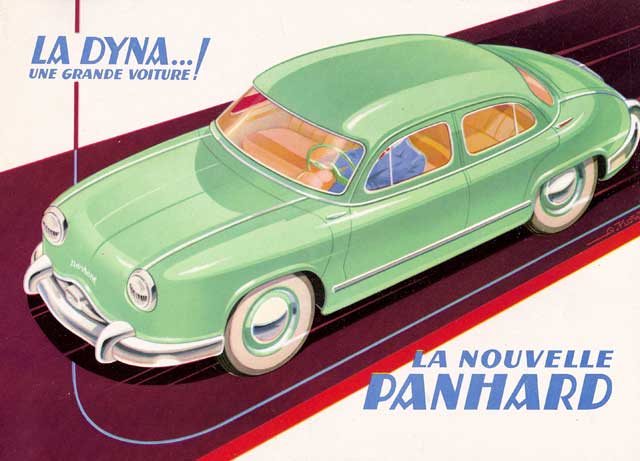
Panhard Dyna Z (1954–1959)

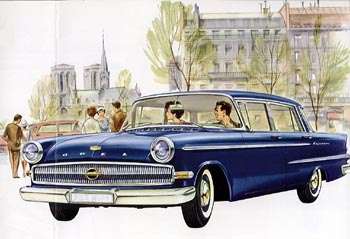
Again a new design. This model, also known as the P-LV, was larger than its predecessor. It still had the panorama-style windscreen, but the completely redesigned rear and lower grille gave the new Kapitän a distinctive appearance.
1960 Opel Kapitan
When production ceased in December 1963 145.616 units had been manufactured.
A completely new design appeared in 1954. The old-fashioned looks had given way to the fashionable ponton shape. It still had the same 6-cylinder 2473 cc engine, although now Opel managed to squeeze 68 hp out of it, giving the car a top speed of 138 km/h.

In 1951 the Kapitän was modernised and given both front and rear end treatment. Technically it remained pretty much the same as the previous model.


The 1947 Opel Kapitän was a roomy six-cylinder saloon based on the 1939 design. In fact the major external difference was its round headlamps (the pre-war models had angular ones). Bumpers, hubcaps and the ‘zeppelin’ mascot were also of a slightly different design. Opel no longer offered two-door or convertible models. Although designated the 1947 model, production didn’t actually commence until October 1948.

1950 Opel Kapitän

From 1950 onwards the car had a column-mounted gear lever and modified bumpers: the horizontal groove no longer covered the entire bumper, but rather just the corner sections, although this brochure for the 1950 model this shows the pre-1950 design.
Specification
1950 Opel Kapitän
Engine
Straight 6, 2473 cc
Power
55 hp @ 3500 rpm
Transmission
3-speed column change
Chassis
Unitary construction
Suspension
Independent front, semi elliptic rear
Brakes
Drum
Top speed
126 km/h
Acceleration n/a
Dimensions
l x w x h: 4.62 x 1.66 x 1.64 m
Packard 1950

NSU Prinz 1958-1973

The 20 horsepower Prinz was introduced in 1958.


Successor to the Prinz was the Audi 50.
NSU Sport Prinz (1958-1967)
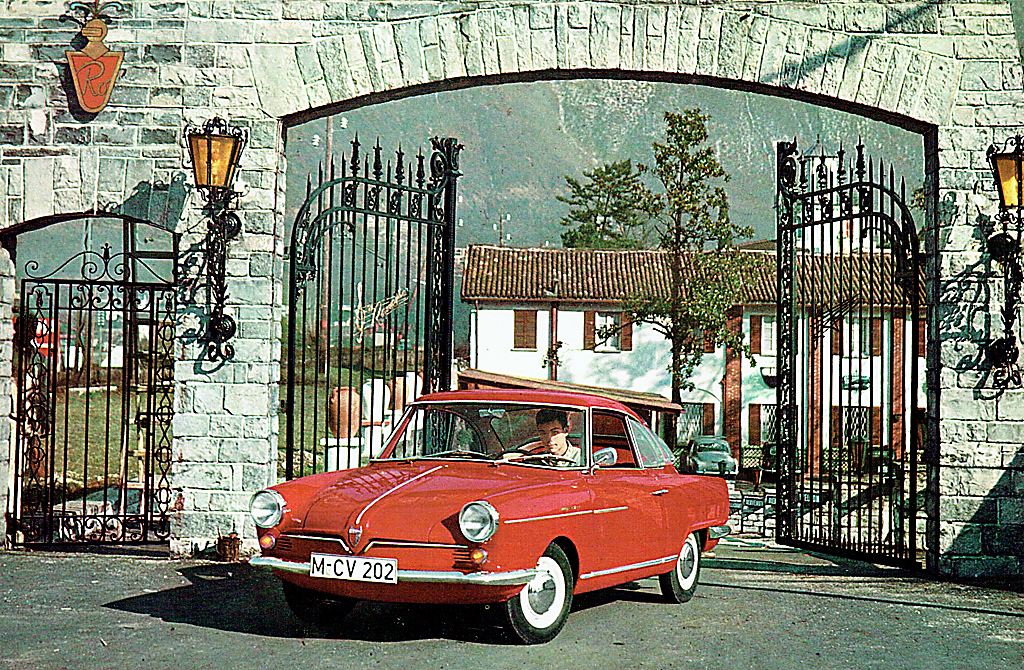
The Sport Prinz was designed at Bertone studios by Franco Scaglione
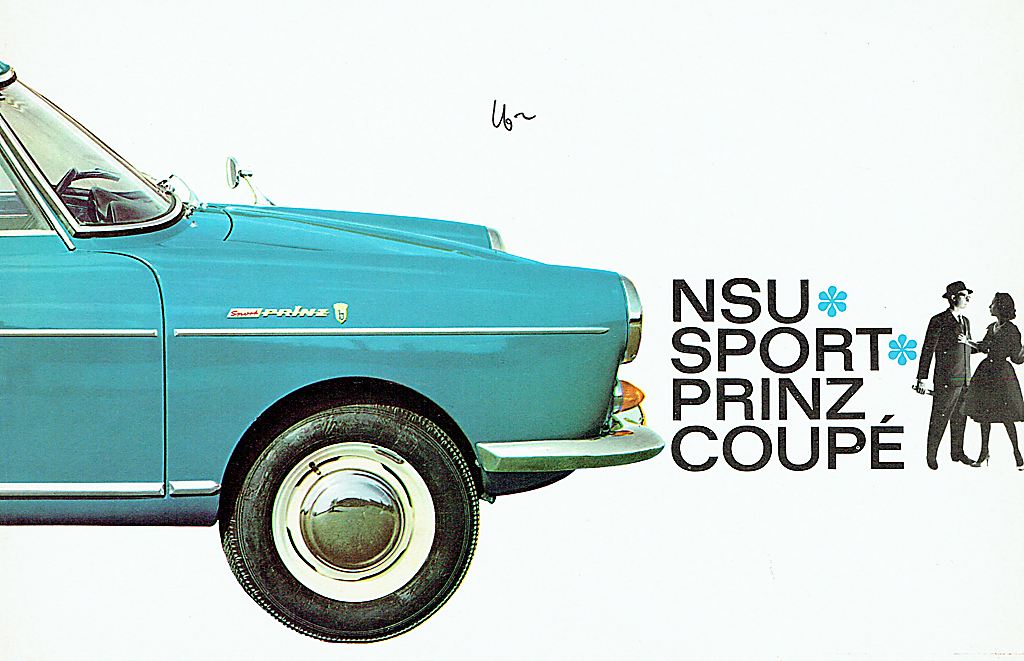
Introduced in September 1958. A two-seater coupé, designed by Bertone, who initially also built the body. The Sport-Prinz’s mechanicals initially came from the Prinz II/III, then from September 1961 onwards from the Prinz 4.
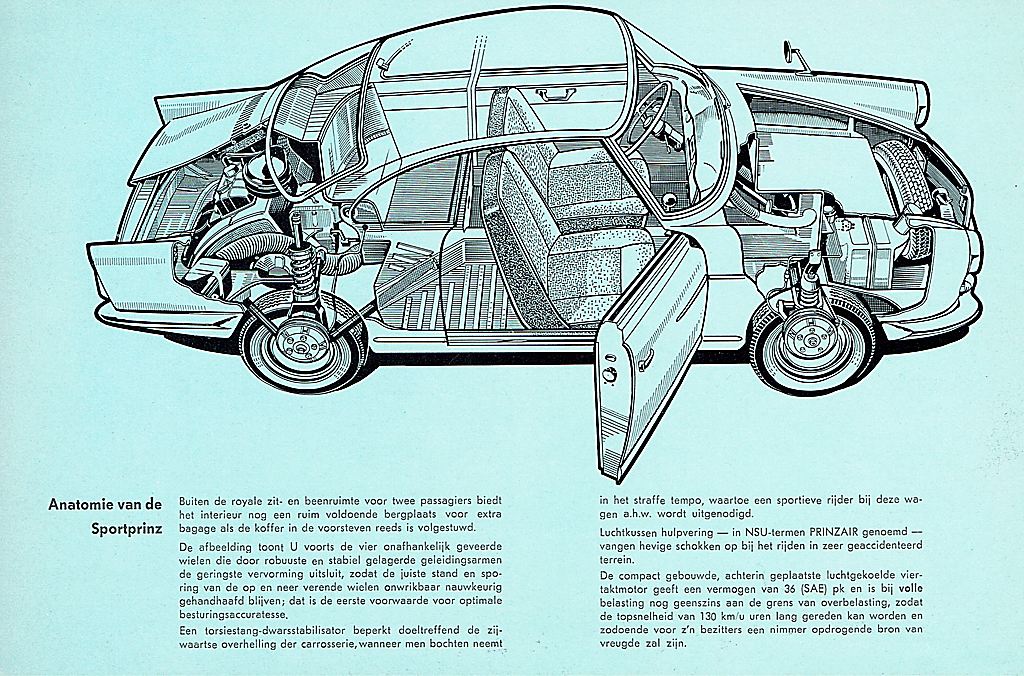
From March 1959 to June 1962, Bertone produced 2,715 cars. The Drauz bodywork factory in Heilbronn produced a further 18,116 cars from November 1960 to June 1967, bringing the total number of Sport-Prinz cars to 20,831.

Initially called the Morris Mini-Minor, the Mini soon became a smash hit all over the world. Its innovative hydrolastic suspension provided superb roadholding, if a little harsh.

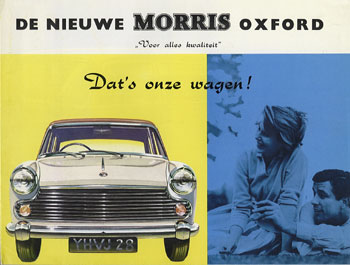
This is the first Oxford with the Farina body style. These were also known as the Oxford Series V and VI. From this point on BMC used the same body for Austin Cambridge. The brochure caption says the car was built in Holland.
Morris Oxford Series V