Morris Isis

Morris Isis (1955-1958)

The Isis was the successor to the SIX. The body style was similar to that of the Oxford, but it sported a 2639 cc six-cylinder engine, giving it a top speed of 140 km/h.

Morris Isis interior

Luxury upholstery
Morris Isis

1956 Morris Isis Series II

The ISIS was discontinued in 1958 in favour of the Wolseley 6/99.

Morris Oxford

Morris Oxford (post-war) (1948-1960)


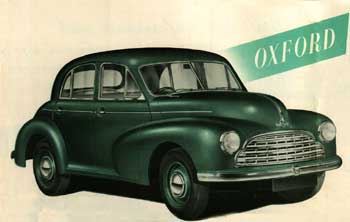
The Morris Oxford MO series was manufactured from 1948 to 1952. The Oxford was the Minor’s big sister. It was fitted with a four cylinder 1.5 litre side-valve engine that produced 41 bhp at 4200 rpm.

1949 Morris Oxford MO

1949 Morris Oxford MO


Morris Oxford Series 2 (1954-1956)

Morris Oxford Series 2


The series II Oxford was a far more modern looking car than its predecessor and was manufactured from 1954 to 1956 when the series III took over. It was powered by a 4-cylinder 1489 cc engine that produced 50 hp. Top speed was 115 km/h.

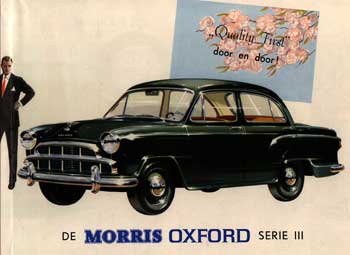
Morris Oxford Series 3 (1956-1959)

The Oxford Series 3 was replaced in 1960 by the Morris Oxford Farina.

Morris Minor

Morris Minor (1948-1971)

Morris Minor
1948 Morris Minor MM

The Morris Minor MM was the first of many versions. Distinguiishing features of this early model are the spilt windscreen and the location of the headlamps in the grille. When the 4-door model came out, the headlamps moved to the wings. It was very much Britain’s answer to the VW Beetle. Production lasted from 1948 till 1971.

Morris Minor
1956 Morris Minor 1000

1948 Morris Minor MM
The engine was a 918 cc side-valve unit carried over from the Series E. The 4-door was fitted with the 803 cc engine from the Austin A30.

220 (W187)

Mercedes-Benz 220 (W187) (1951-1955)

The 220, introduced at the Frankfurt motor show in 1951, was fitted with a 2195 cc six-cylinder engine that gave the car 80 hp. Bodywork was essentially the same as the 170 S, except for the headlamps now having been integrated into the wings.

1952 Mercedes-Benz 220

1952 Mercedes-Benz 220
952 Mercedes-Benz 220 Cabriolet A


In addition to the saloon there were convertible models, the Cabriolet A and the Cabriolet B. Despite its elegant looks, only 1278 Cabriolet As were produced. This was better than the Cabriolet B of which only 997 were sold.


The artists definitely did their best to make the car as attractive as possible. The dark red Cabriolet A shown here looks more the size of a 300. The cream-coloured one below is shown as being far more elegant than the mediocre saloons (Wartburg?) in the background.

MB 220
1952 Mercedes-Benz 220 Cabriolet A

Specification
1952 Mercedes Benz 220 S

Engine
Straight 6, 2195cc

Power
80 hp @ 4850 rpm

Transmission
4 speed synchromesh

Chassis
X chassis

Suspension
Independent front and rear

Brakes
drum

Top speed
140 km/h

Acceleration
0-100 km/h: 21 s

190 SL (W121)

Mercedes-Benz 190 SL (W121) (1955-1963)


Overshadowed by the 300SL, the four-cylinder 190SL is a fine car in its own right. It was built from 1955 to 1963.

MB 190 SL
1955 Mercedes-Benz 190 SL


The 190 SL was available as a roadster, coupé and a combination: coupé/cabriolet. Mercedes-Benz also offered a sports roadster version, of which only a few were sold.

Engine
Straight 4, 1897cc

Power
105 hp @ 5700 rpm

Transmission
3 speed automatic

Chassis
Unitary construction

Suspension
Independent front, swing axle rear

Brakes
Top speed
175 km/h

Acceleration
0-100 km/h: 14.5 s

170 S (W191)

170 S (W191) (1949-1955)


The 170 S was introduced at the Hannover motor show in 1949. It was based on pre-war designs. Initially is shared the chassis designation W136 with the 170V, but in 1952 it was upgraded and became the W191. The bodywork was similar to that of the 230 (W153). Its all-round independent suspension gave the car an edge on the competition.

1949 Mercedes-Benz 170 S

1949 Mercedes-Benz 170 S

1949 Mercedes-Benz 170 S
Engine1767 cc 4-cylinder 4-stroke
Power52 hp @ 4000 rpm
Top Speed122 km/h
Acceleration0-100 km/h in 32 sec
ChassisX chassis
SuspensionIndependent front and rear
Brakeshydraulic drum front and rear
Lengthin mm
Widthin mm
Heightin mm
Weightin KG
Specification

170 V (W136)


170 V (W136) (1937-1953)

The 170 V was introduced in 1937 as the successor to the Typ 170 (W15). The model received a couple of facelifts in the course of the years. In 1952 for instance, the louvres on the side of the bonnet (hood) were replaced by two horizontal strips. The spare wheel cover was an optional extra.

1952 Mercedes 170 V

The “V” in the 170 V’s name was an abbreviation of “Vorn” (front), added to differentiate it from the contemporary rear-engined Mercedes-Benz 170H (W28). “H” stands for “Heck”, rear).


A luxury version of the 170 was introduced in 1949: the slightly larger 170S (W191).

MG Magnette

MG Magnette (1953-1968)

MG is famous for its sports cars, but the saloons have always had a fair following. Most of them are badge-engineered models from the BMC stables (see Austin, Morris, Riley or Wolseley for similar vehicles).

1957 MG Magnette

1957 MG ZB Magnette


The MG Magnette ZA was introduced in October 1954. Easily recognisable by the curved chrome moulding on the front wing.

In 1956 the ZA was replaced by the ZB. It gained more power (twin 1.5 inch SU carbs and 64 bhp compared to twin 1.25 inch SU carbs and 60 bhp of the ZA ) and can be identified by the straight chrome moulding on the front wing.
1958 saw the advent of a new version of the ZB with a large panoramic rear window and a two-colour paint scheme, known as the ZB Varitone. A chrome strip all along the side of the car separated the two areas of colour.

MG Magnette ZB

Production of both ZB models came to an end late 1959 when the MkIII was introduced. Not designed by BMC themselves this time, but by Pinin Farina. Engine and other mechanical components were carried over from the ZB, but it was now very different style of motor car, built on the aging Austin A55 platform. Certainly not what you would call a “Sports saloon”.

MG Magnette MK 3

MG Magnette MK 3

In 1961 the MkIV was introduced. It had a more powerful engine anad improved suspension, which gave it roadholding capabilities that were comparable to the ZB.

The most obvious difference between the MkIII and the MkIV is the detailing of the wheels.
The MkIII had steel rims whereas the MkIV was fitted with wheel trim.

(Based on information kindly supplied by Gerard Jansen)

MG T-type

MG TA, TB, TC, TD & TF Midget (1936-1955)

MG TC

1945 MG TC
1949 MG TD

MG TF
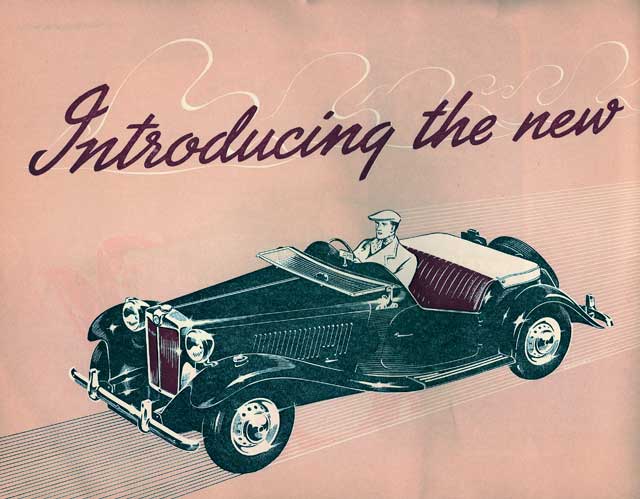
The TF was disliked by ‘real’ MG enthusiasts when it first appeared, though the publicity staff at the Nuffield Organisation were quite elated. Below is a scan of the original press release.

STRICTLY CONFIDENTIAL AND NOT FOR PUBLICATION BEFORE FRIDAY, 16TH OCTOBER [1953]

NEW VERSION OF RENOWNED SPORTS CAR

M.G. “T.F.” MIDGET HAS GREATER POWER

A restyled body with a more idealised shape, increased power output, and detail modifications to improve comfort and accessibility are among the many outstanding features of the new M.G. TF Midget announced by The Nuffield Organisation today.

The alterations were carried out after careful research in world markets, especially in the United States where 25,000 M.G. Midgets have been sold since 1946.

A cross section of consumer-dealer opinions showed that eighty per cent of M.G. owners do not want their cars for competition or racing, but do demand a high performance capability combined with durability and traditionally smooth riding.

The engine is basically the same efficient, reliable 1250 c.c. unit, but the power output has been increased to 57.5 b.h.p. at 5,500 r.p.m. It is, in fact, the Mk. II engine formerly offered as an alternative in the T.D. model. This has been achieved by raising the compression ratio to 8:1 and using twin S.U. carburettors of 1″ diameter with enlarged inlet ports. Extra large valves (inlet 36 m.m. exhaust 34 m.m.) are fitted with 150 lb. valve springs to enable engine speeds up to 6,000 r.p.m. to be attained without valve bounce.

The radiator, retaining the distinctive appearance of the marque, curves back to meet the downward. slope of the bonnet and the front wings have been reshaped to shroud the headlamps. The bonnet sides are now fixed valances and the centre-hinged top is opened easily and quickly by two push buttons on either side.

The 12 gallon petrol tank, with quick release filler cap, has also been reshaped to bring it lower and this greatly contributes to the new over-all line of the car.

A map-reading light is included in the instruments now grouped in the centre of the facia panel – on either side of which is an open glove box – and the electric drive motor for the twin-blade windscreen wiper is concealed beneath the scuttle. Direction indicators are now fitted, with the switch on the facia.

This model is available either with steel disc wheels or with knock-on wire wheels at a moderate additional cost. Optional extras include badge bar, fog lamp and luggage carrier, which may be obtained through M.G. retailers.

The ‘T.F.” is available in black with red, green or biscuit upholstery, M.G. red with red or biscuit upholstery, green with green or biscuit upholstery and ivory with red or green upholstery.

With the compliments of The Nuffield Organisation,

Central Publicity Department, Cowley, Oxford

MG A

MG A (1955-1962)

MGA
MG A

MGA
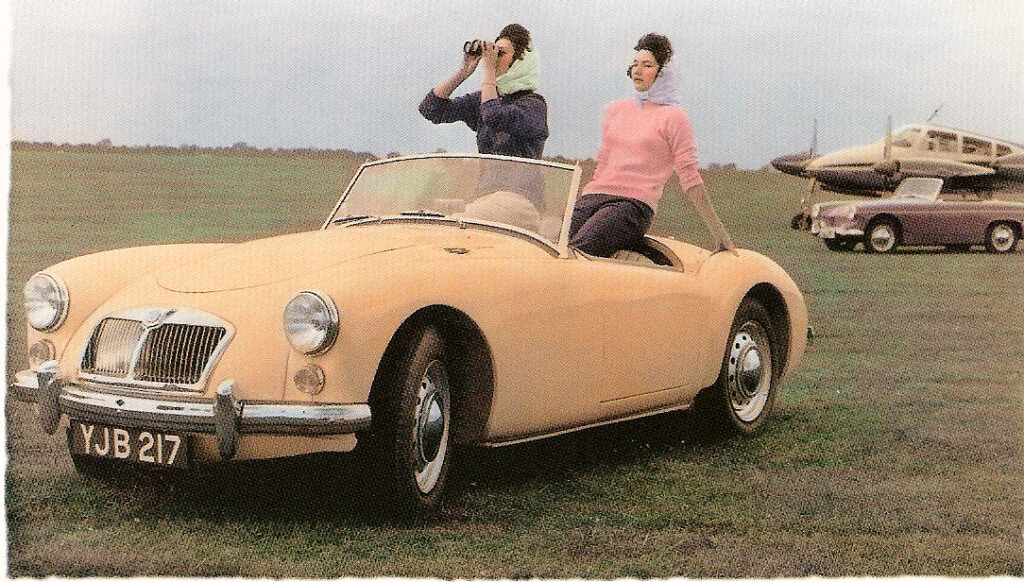
1959 MG A 1600