The 96 was first introduced in 1960. The main difference between it and its predecessor was the larger rear window. The engine had grown to 841cc and now produced 38 hp.
1962 SAAB 96
The GT850 (later known as the Saab sport in Europe and Montecarlo 850 in the USA) was introduced in 1962.
Another face-lift appeared in 1965 when modifications to the engine demanded more space.
SAAB 96
1965 SAAB 96 SAAB engine
3 cylinder 2-stroke The engine was fitted with triple carbs in 1966.
From 1967 on SAAB offered a 1500cc V4 engine originally designed for the 1962 Ford Taunus 12M. In 1968 only 28 cars were sold with the two-stroke unit, as opposed to 30,000 with the V4. The two-stroke was subsequently dropped altogether.
Specification (1960 SAAB 96)
Engine 3 cylinder 2-stroke, 841 cc Power 46 hp @ 5000 rpm Transmission 4 speed manual Chassis Unitary construction Suspension Independent front, rigid rear Brakes drum/drum LxWxH 402x157x148 cm Weight 815 kg Top Speed 131 km/h
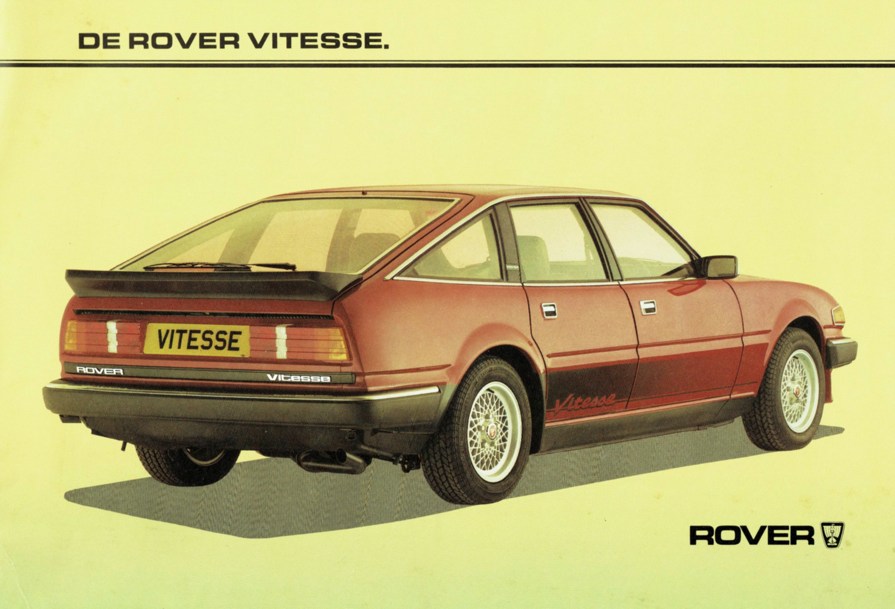
When it was launched in June 1976, the Rover SD1, was a very bold step forward by Rover standards. Gone was the Auntie Rover image and in its place was a new low drag sporty hatchback.
Rover SD1 2000
Inspired by the Ferrari Daytona, designed by Director of styling David Bache, the 3500, with its 155 BHP V8 engine, showed great promise. Initially very successful, but after a while things started to go wrong, such as paint problems, water leaks, rust, and poor reliability.
The Rover won the coveted European Car of the Year award in 1977.
1977 Car of the Year #COTY
1982 brought the launch of the Series 2 models, with revised trim levels and body updates, now with most of the problems with paint and reliability behind it, as well as new models being introduced, sales improved.
1985 Rover SD1
Rover SD1 Vitesse
Last in the range was the Vitesse and production ceased in October 1986. In all about 300,000 SD1s were produced.
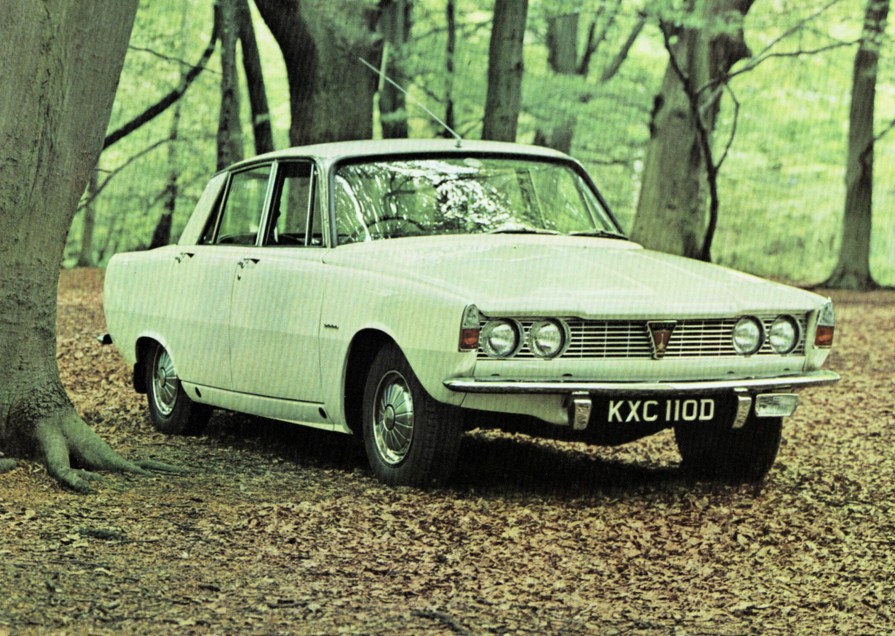
Introduced in 1963, the stylish 2000 was a complete break with tradition (the P4 was still available). It had a monocoque base with bolt-on body panels. The OHC engine was completely new. Automatic and twin-caburettor models arrived in 1967.
1967 Rover 20001967 Rover 2000Rover P6 2000 TC
1967 Rover 2000 Apart from minor detail changes like rear light style, wheel trims and badge design the P6 remained unchanged until the facelift in 1970/1. Post-1971 models are identified by re-styled black plastic radiator grille, new bonnet with bulges and wheel trim. The quarter panels were covered in black vinyl, sills were painted satin black unless a brown vinyl roof was fitted, in this case both the quarter panels and sills were brown. The Rover emblem was also moved to the bonnet. The 2200 of 1974 had a larger engine.
Rover ‘RV8’ engine
The ex-Buick 3500 engine was shoehorned into the P6 to become the Rover Three Thousand Five. Initially it was only available with Borg Warner automatic transmission. The 3500S, announced in 1971, was equipped with a 4-speed all synchromesh gearbox. 1974 cars were fitted with sundym windows and vinyl roofs.
This was Rover”s first monocoque model. It acquired front disc brakes in 1960. The Mark 2 arrived in 1962. The Coupé version was introduced at the same time.
Rover introduced the 3.5 litre, known as the P5B, in 1967. As with the 3 litre, it was available both as Saloon or Coupe. The P5 (3 Litre) had an option of a manual or automatic gearbox. The P5B (3.5 Litre) was only available as an automatic.
The differences between the two models are: wheels, chrome Rostyles on the P5B, straight side moulding as opposed to a sharp angle on the P5, no hole in the front grille for the starting handle, rubber strips on the over-riders and recessed fog lamps in the front wings on the P5B
1967 Rover P5 3.5 litre CoupéLuxurious interior
Between 1959 and 1973 Rover produced almost 70,000 P5s.
The Peugeot 404 came out in May 1960. Like its predecessor the 404 was designed by Pininfarina. Its angular styling was similar to that of the BMC A55 and Fiat 1800.
In all, Peugeot manufactured 2,779,926 404s. It was available in a number of body styles, including a coupé, cabriolet, break (station wagon), familiale (7-seater) and numerous commercial vehicle versions.
Production lasted until 1975 in Europe. It continued to be produced in Kenya until 1991!
404
1961 Peugeot 404
Specification 1971 Peugeot 404 76 hp Engine 1618 cc 4-cylinder Power 72 hp @5400 rpm Transmission 4 speed manual Chassis Unitary Suspension Independent front, rigid rear Brakes Disc brakes front, drum brakes rear Top speed 148 Acceleration 0-100 km/h 17,8 sec Dimensions LxWxH 4,45×1,62×1,45 m