A very advanced design for its time, the Peugeot 204 was introduced in 1965.
204
1971 Peugeot 204
Specification 1971 Peugeot 204 Engine 1130 cc 4-cylinder Power 60 hp @ 5750 rpm Transmission 4-speed manual Chassis Unitary Suspension Independent front and rear Brakes Disc brakes (front) drum brakes (rear) Top speed 140 km/h Acceleration 0-100 km/h in 18.5 sec Dimensions LxWxH 3,99×1,57×1,40 m
The world’s first production Wankel-engined saloon. Caused quite a stir when first announced. Roadholding was excellent but engine reliabilty was initally a great let-down.
Initially called the Morris Mini-Minor, the Mini soon became a smash hit all over the world. Its innovative hydrolastic suspension provided superb roadholding, if a little harsh.
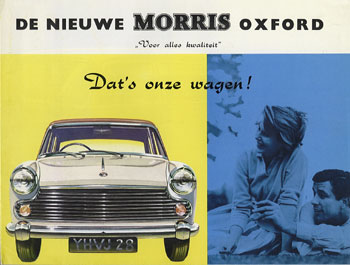
This is the first Oxford with the Farina body style. These were also known as the Oxford Series V and VI. From this point on BMC used the same body for Austin Cambridge. The brochure caption says the car was built in Holland.
The Morris Minor MM was the first of many versions. Distinguiishing features of this early model are the spilt windscreen and the location of the headlamps in the grille. When the 4-door model came out, the headlamps moved to the wings. It was very much Britain’s answer to the VW Beetle. Production lasted from 1948 till 1971.
1956 Morris Minor 1000
1948 Morris Minor MM The engine was a 918 cc side-valve unit carried over from the Series E. The 4-door was fitted with the 803 cc engine from the Austin A30.
The ADO16 – Morris 1100 (and its sister car, the Austin 1100) were very popular in their day. They shared the concept of hydrolastic suspension with the mini but were a larger car altogether. In Holland the car was known as the ‘Glider’ (at least the Austin version was) and in Denmark, as the above advert from a Danish newspaper shows, it went by the name of Marina. British Leyland later used the Marina name for the 1100’s successor. The Morris 1100, two and four door models, were launched on August 15th 1962 . The Morris 1100, like its smaller sister, the Mini, was designed with a tranverse engine and front wheel drive, which gave the car lots of space for the passengers and their luggage, and of course great roadholding. In October 1962, the MG 1100 two door and four door versions were announced. Fitted with a twin-carburettor version of the 1098cc A series engine, this model featured the traditional MG front grille and more luxurious trim. Other variations included the Wolseley Wasp, Riley Kestrel and VandenPlas Princess 1100 models. Innocenti of Milan also produced a version of the 1100. The Austin 1100 models, introduced in September 1963, differed from the Morris version only in that the typical Austin grille (eight bars) and a different facia panel layout were adopted.
The 230 was the successor to both the 190 SL and the 300 SL and was perceived by many as a bit of a compromise. Its unusual roof -lower in the centre than at the edges- soon earned the car the epithet ‘pagoda roof’ because of its similarity with oriental temples.
1963 Mercedes-Benz 230 SL
The W113 SLs were built from 1963 to 1971, starting off as the 230 SL. The 250 SL was introduced in 1969 and the series ended as the 280 SL in 1971.