IFA F9 (1950-1956)
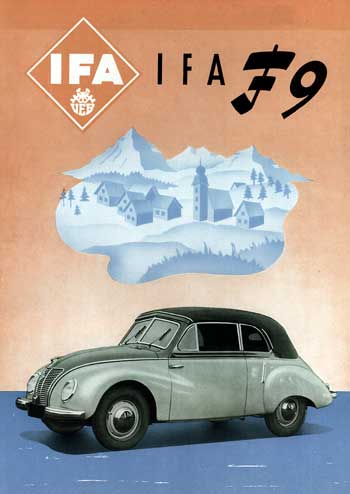
The IFA F9 was succeeded by the Wartburg.


Hillman Husky 1957

The Husky was a short wheel-base station wagon, based on the Minx.
The new “Series” Minxes were completely re-designed for the 1957 model year. The car was designed by Raymond Loewy studios.
Minx Series 1

1957 Hillman Minx Series I
Minx Series II
1957 Hillman Minx Series II
The Series II had a new grille. The Jubilee was a double: 50 years of Hillman and 25 years of Minxes
Minx Series II
1957 Hillman Minx Series II
The Series III got a new grille, with the Hillman name placed above it. The IIIa grille was different (split) – the IIIb’s grille looked the same, but was made of aluminium. The IIIa got tiny fins at the rear. The IIb was also fitted with a Hypoid rear axle. The cars looked identical, so Rootes didn’t bother with a new brochure – they just changed a couple of words on the ‘specifications’ page.
Hillman Minx Phases 2 to 8 (1947-1957)
The Hillman models were referred to as ‘Phases’ or ‘Marks’. Phase 2 to 8 models were very similar.


This new two-tone colour scheme was referred to as the ‘Gay Look’. The chrome strip running the entire length of the car differentiates it from the Phase 8. The brochure describes it thus: ‘New side moulding in chrome and bolder number plate plinth for extra smartness!’ The Convertible and Californian retained their Phase 8 looks.
Ford Edsel

Ford Versailles 1955
Now advertised as “French design, European finish, American technology”, but still as a Ford (brochures published by Ford Motor Company (Belgium) S.A. and N.V. Nederlandsche Ford Automobiel Fabriek, Amsterdam).
Ford Versailles 1955

1955 Ford Versailles
Available in other two versions, the Trianon, the Régence, with the Versailles in between. Its side-valve V8 had grown to 2353cc.
The reviewer in the 10 December 1955 issue of Bedrijfsvervoer was enthusiastic about its performance (0-100 km/h in 20 seconds, top speed of 139 km/h) and road holding, saying the Versailles is almost a sports car! The reason for a road test was an invitation, by the Dutch Ford Works, to become reacquainted with a ‘lady’ who had an American father and a French mother, who had just remarried (i.e. Simca).
Versailles models

Versailles models
Ford SAF was aquired by Simca in 1954. Some Ford models were carried over and rebadged as Simcas, although not in all markets.
By 1953 the Vedette had acquired a modern one-piece windscreen. A Dutch brochure boasts about the vehicle being manufactured at the Amsterdam works, but reassures the reader that it is an American design and is constructed under the supervision of American engineers (no mention of France here).

A road test in the 18 December 1954 issue of Bedrijfsvervoer magazine notes that French Ford’s reputation was at an all time low, but that opinion was based on the first few years after the war, when materials were scarce and quality was less of an issue. Nowadays (1954) the French Ford is just as good as any Ford product. This apparently explains the stress on ‘American’ in the Dutch brochures.
1954 Ford Vedette Sunliner
The Vendôme sported a 3923cc V8 engine and according to the Dutch brochure was at one point available upon request only!
Ford Vedette 1951
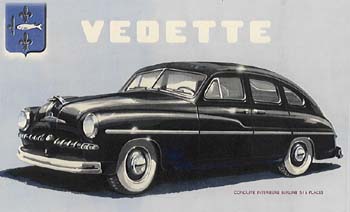
The 2158 cc V8 engine was advertised as being smooth, silent en economical and the most important selling-point was the fact that the engine was a product of Ford de Poissy (as opposed to the rest of the vehicle, which was of American design). This is from a French brochure