Ford Comete 1951-1954
The Comete was billed as The French Luxury Car. The bodywork was by Facel, but the engine was the 2158cc V8 unit used in the Vedette. The undated brochure sports the Ford logo, unseen on any other Ford S.A.F. product!


The Comete was billed as The French Luxury Car. The bodywork was by Facel, but the engine was the 2158cc V8 unit used in the Vedette. The undated brochure sports the Ford logo, unseen on any other Ford S.A.F. product!
Ford Taunus 12M & 15M 1955-1957 (Weltkugel)


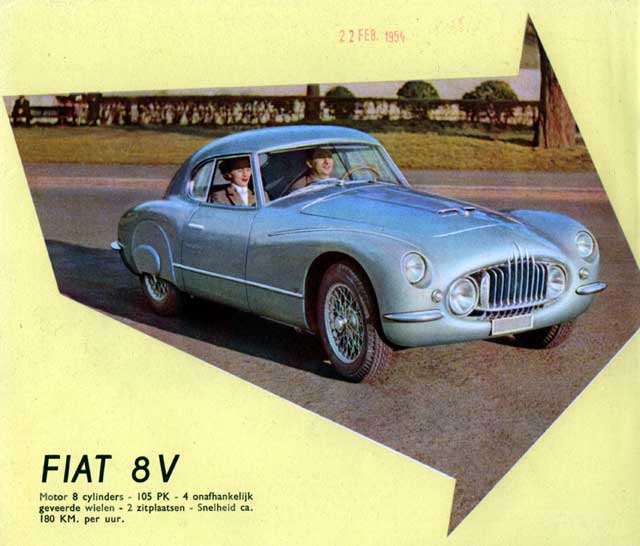
The Otto Vu (Italian for V8) was available with standard factory bodywork, but famous coachbuilders such as Vignale, Zagato and Ghia also used the V8 as a basis for some exquisite masterpeices. Now very sought-after, Otto Vus can be frequently spotted at concours d’elegance shows all over the world.

The Fiat 600 was introduced in 1956 and was an immediate success. The model shown here is the first one, easily identified by the front opening doors and the direction indicators on the top of the front wings
Fiat 600 D

This one still has front-opening doors, but the indicators have been moved to the front and sides.

Forerunner of the MPV. It actually did seat 6.


Popular to this very day. Great for a day out in the country: four of them obviously came in the Giardiniera, the other two in the 500 D, and I suppose the photographer came in the back seat of the 500 D. . .
Specification Fiat 500 D
| Engine | 499.5 cc air-cooled 2-cylinder 4-stroke |
| Power | 17 hp |
| Top speed | 85 km/h |
| Transmission | 4 speed manual |
| Suspension | front: independent, transverse leaf ; rear: semi-trailing arms |
| Dimensions | lxbxh 3.18 x 1.32 x 1.35 metres; 555 kg |

Fiat 1500 1935-1950

The 1500 E was the last version of the 1500 that had been introduced in 1935.

Fiat 1400 B

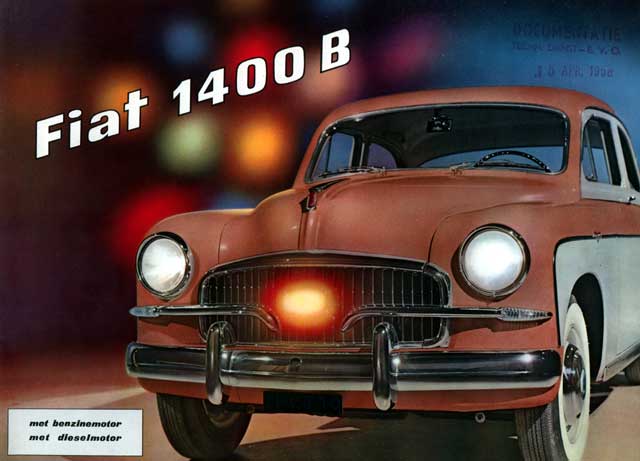
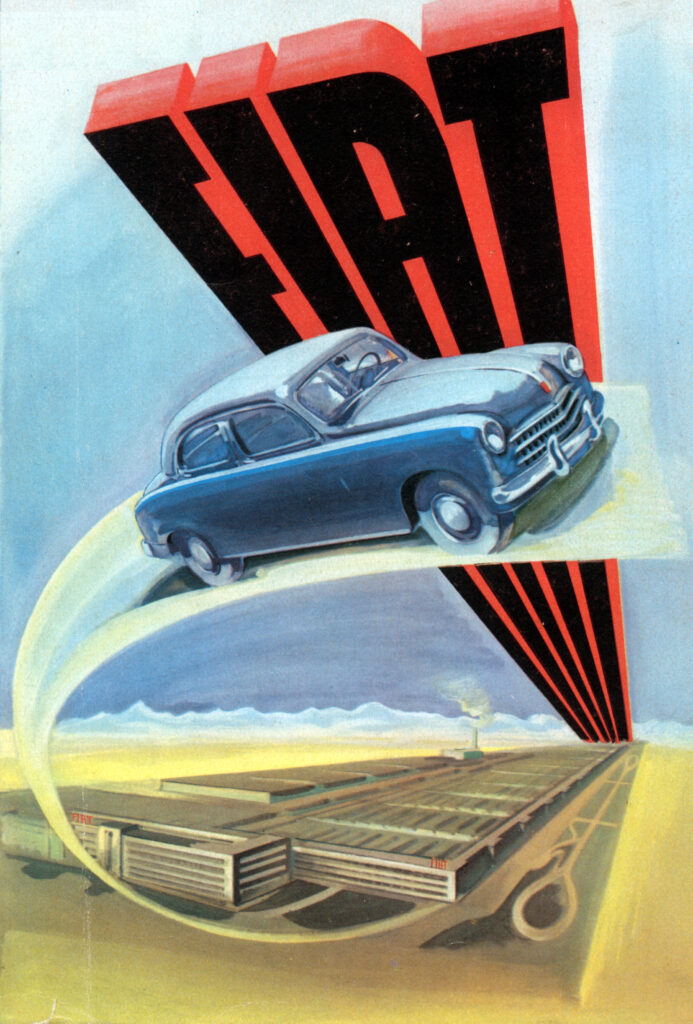
The following is the introduction to the ‘Salesman’s Guide’ for the Fiat 1400 issued by Fiat, April 1950.
THE CAR OF PROGRESS
Any new car can aspire to be named after progress: better today than yesterday, at least in intention, even if only on the data of experience. But for the ‘1400’ this is no presumption. The advertising slogan ‘car of progress’ corresponds to actual fact, both in comparison with what has been done hitherto, and as a new trend in automobile building towards the future. This is so true that in the drawing offices and the workshops the ‘1400’ is currently designated by the number ‘101’, as if to indicate a fresh start from the base 100. A new chapter. What are the essential aspects of the industrial progress of the automobile? Chiefly these:
mechanical progress of all its parts in order to increase, through a still better balance between the parts and their functions, the efficiency and reliability of the car;
progress in the convenience, roominess and comfort of the car;
progress in economy, both in purchase price and running costs, with due consideration of the car’s brilliant features.
The aim of this triple order of improvements is a car of still simpler and safer construction, still easier to drive, still more utilitarian in performance and more convenient, comfortable and economical. In short, a longer lasting car cheaper to buy and to run.
The ‘1400’ is on this road, where it reaches a goal which is also a starting point for further outstanding stages of progress. From the point of view of construction, engineering and coachwork, the ‘1400’ embodies the elements of a new constructive era. It begins a series of new models: the “car of progress” series. The ‘1400’ will be one of the chief attractions at this year’s International Motor Shows, beginning with those of Geneva and Turin. One of the first things to say and to draw attention to about the “1400”, before entering into a technically detailed description of the car, is this: the “1400” is of frameless construction. This is not an absolute novelty: some manufacturers are already using this system; but in Fiat production it is an important innovation to which due attention must be drawn. ‘Frameless construction’ means the abolition of the conventional chassis frame. The body is built in one piece and carries on its bottom all the mechanical parts. In the ‘Salesman’s Guide’, which forms part of this Bulletin, the important feature of the ‘frameless construction’ is explained in its technical details and in its practical advantages. It may be useful to explain here that, in general, the ‘frameless construction’ is a logical constructional idea. Is not a ship just a shell, the hull, containing within it all the propelling machinery? It is the same with an aeroplane: engine, propeller and wings form a single whole with the flying shell. The motor car, which originated as a motor driven chassis, with a body mounted on it, a body separately built and then fixed to the frame, later became – like the ship and the aeroplane – chiefly a shell (the coachwork) carrying the mechanical components, and no longer the other way about.
ALL THE NEW SOLUTIONS USED IN THE “1400” ARE COVERED BY FIAT PATENTS


This is the successor to the 1100 TV and was also known as the 1200 TV. Great styling, similar to that of the Simca Aronde Océane & Plein Ciel of the same era.