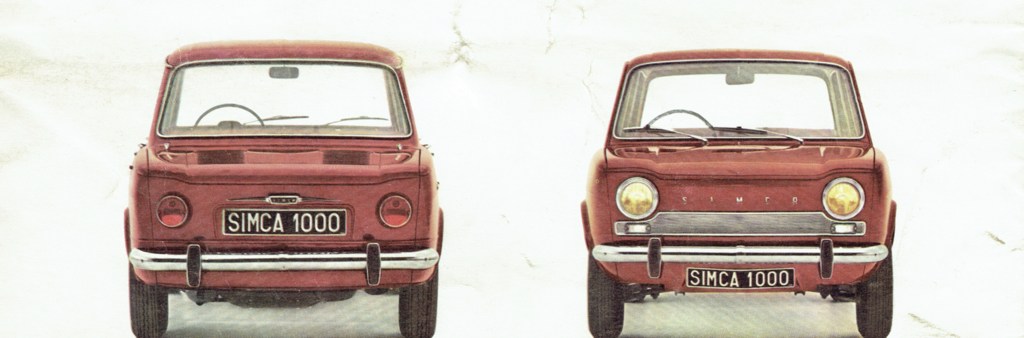
The Simca 1000 was an immediate success when it was launched at the 1961 Paris Salon, It remained in production for 16 years In all, 1.6 million units were made.
Simca 1000
What they said at the time: “One of 1962’s sensations was the introduction by Simca of their first rear-engined car, the 1000. Although the power unit employed, a 944 c.c. version of Simca’s five-bearing 1290 c.c. Rush engine, is their smallest, it develops 45 b.h.p. at 5,000 r.p.m. and a maximum torque of 54.2ft/lb at 2.800 r.p.m., giving a maximum speed of 75 m.p.h. Suspension is independent, front and rear, and there are 9 in hydraulic drum brakes all round. The electrical system is 12v. The engine revolves counter-clockwise, the opposite of classic engines, in order to compensate for torque and improve balance at any speed. The integral transmission/rear axle assembly is compact and fully synchronised.
1963 Simca 1000
Although it is a small and economical car. the 1000 has many refinements. Its four doors open at right angles: the luggage boot locks from inside the car. The ventilation system allows both air flow and temperature to be regulated. The separate front seats have contoured triple-padded backs and a no-sag frame: they have seven adjustment positions, which can be changed while the car is moving. Sound insulation is effective. There are two sun visors, matching either of two ceiling tones.”
1962
1974
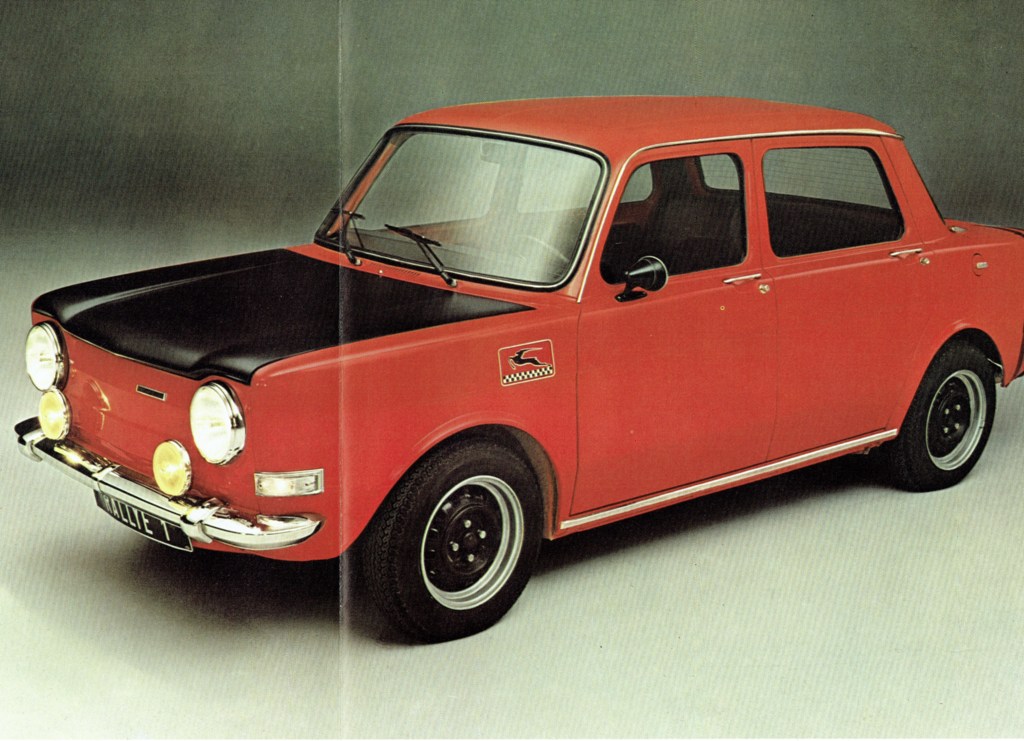
1974 Simca 1000Simca Rallye 1Simca Rallye 2
The Simca 1000 Rallye 1 and 2 were popular among the more sporty motorists and with racing drivers, both in one-make championships and in saloon car racing.
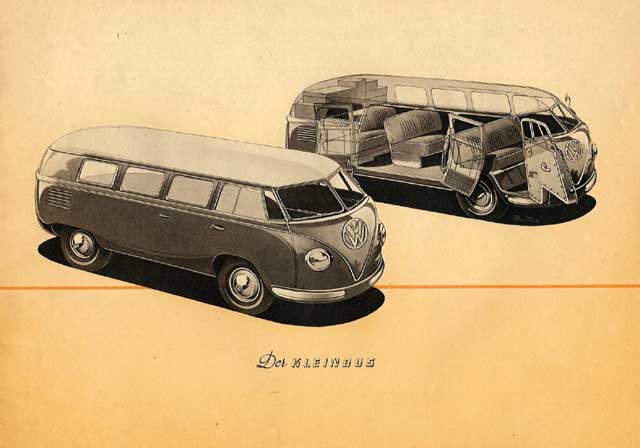
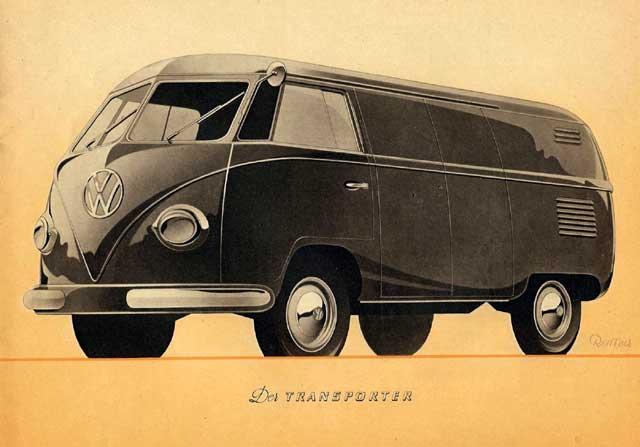
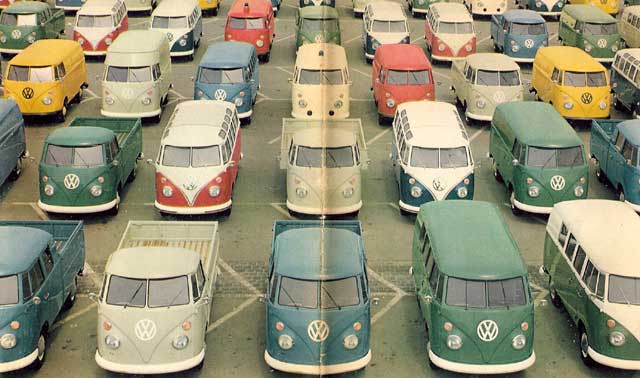
The transporter, bus or Bulli as it is known in Germany, has gained cult status. The Dutch VW importer, Ben Pon, is said to have made the first sketches for the Transporter. There have been 6 generations up to 2021, known as T1 to T6.
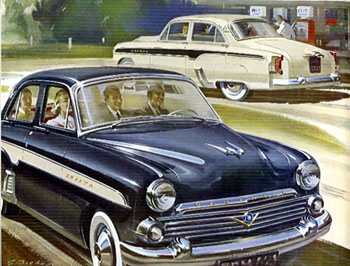
The Vauxhall Cresta was from 1954 to 1972. The Cresta was introduced in 1954 as an upmarket version of the Vauxhall Velox, itself a six-cylinder version of the Vauxhall Wyvern. The Cresta models were the E (1954–1957), PA (1957–1962), PB (1962–1965) and PC (1965–1972). The Viscount (1966–1972) was an upmarket Cresta PC.
Vauxhall Cresta
1955 Vaxhall Cresta1957 Vauxhall Cresta
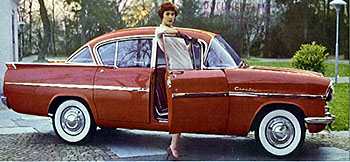
1958 Vauxhall Cresta
The US-styling of the 1958 Vauxhall Cresta was quite a shock (as were the colour schemes), nevertheless 1958 was a record year for Vauxhall, with 114,117 cars sold.
Engine 4 Cylinder 1496 cc Power 52.5 hp @ 4500 rpm Transmission 4 speed manual Chassis Unitary construction Suspension Independent coil spring front, semi-elliptic leaf springs rear Brakes Lockheed hydraulic drum brakes Top speed 80 mph Acceleration Dimensions LxWxH 4.15 x 1.54 x 1.50 m
Data sheet, itself an extract from Saab Sonics no. 21
The SAAB SONETT SUPER SPORT
“The greatest sensation at the 1956 Stockholm Motorcar Show (with more than 400 different cars on show) was undoubtedly the Saab Sonett Super Sport, built by Saab’s Motorcar Division at Trolhattan. An experimental car, the Saab Sonett Super Sport has been built mainly to enrichen Saab’s experience in the design of advanced cars. As far as the chassis is concerned, the Saab Sonett is to nearly 100 per cent built on the standard Saab-93 chassis. The car is equipped with a Saab-93 engine, which has been boosted to give 57.5 h.p. at 5.000 r.p.m. (as against 38 h.p. in the standard Saab-93 car). Max. torque is approx. 63 lbs.ft. (9 kpm) at 3,500 r.p.m. By building the Saab Sonett, the motorcar division will get an opportunity to test the Saab-93 engine under exceptional conditions. Another design feature tested in connection with the construction of the new car is the glass fibre laminate (plastics) used in the body of the car. The most interesting design feature is perhaps the box type design used for the mounting of the chassis details. This has been built according to aircraft design principles and is of light metal. Thus, a very low weight of the unit (71 kg.) has been obtained. The work on this car has been directed by Mr. Rolf Mellde, Chief Test Engineer at Saab’s Motorcar Division at Trollhattan. An experimental series of 5 cars is now being built.”
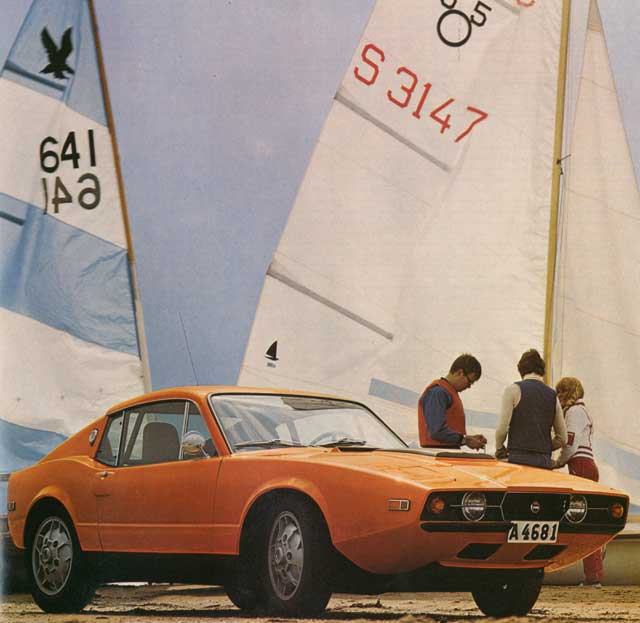
Although some books claim that the car shown at the Stockholm Motor Show remained a one-off, it seems that there are 6 Super Sports still in existance today (thanks to Robert Miller for pointing this out). It was not until the early ’60s that the idea for a sports car was revived. The Sonett II was introduced in 1966. In 1970 it was restyled by Italian Coachbuilder Sergio Coggida and produced as the Sonett III.
The 99 was introduced in 1968. It had a 4-cylinder 1700 cc 85hp in-line engine designed by Triumph. From 1970 onwards It sported many advanced features such as heated front seats and headlamp washers.
The 96 was first introduced in 1960. The main difference between it and its predecessor was the larger rear window. The engine had grown to 841cc and now produced 38 hp.
1962 SAAB 96
The GT850 (later known as the Saab sport in Europe and Montecarlo 850 in the USA) was introduced in 1962.
Another face-lift appeared in 1965 when modifications to the engine demanded more space.
SAAB 96
1965 SAAB 96 SAAB engine
3 cylinder 2-stroke The engine was fitted with triple carbs in 1966.
From 1967 on SAAB offered a 1500cc V4 engine originally designed for the 1962 Ford Taunus 12M. In 1968 only 28 cars were sold with the two-stroke unit, as opposed to 30,000 with the V4. The two-stroke was subsequently dropped altogether.
Specification (1960 SAAB 96)
Engine 3 cylinder 2-stroke, 841 cc Power 46 hp @ 5000 rpm Transmission 4 speed manual Chassis Unitary construction Suspension Independent front, rigid rear Brakes drum/drum LxWxH 402x157x148 cm Weight 815 kg Top Speed 131 km/h
The 93 was introduced in December 1955. A 748cc 53hp 3 cylinder engine replaced the original 2 cylinder unit. Coil suspension was used instead of torsion bars. The car had a restyled front.
1957 SAAB 93B
1957 SAAB 93B
NEW SAAB-CAR PUT ON THE MARKET
Ten new features of the 1958 Saab There are many important innovations on the new model of Saab-93 now put on the market. The most striking feature of the Saab-93B, as the new model is called, is the undivided. arched wind-screen enclosed by an elegant metal. In conjunction with the new windscreen, there are improved wind-screen wipers, which have a considerably expanded cleaning surface. A three-position, vertically adjustable back seat is an advancement that many will appreciate. In the highest position even the small children get a good view. Double-acting door stops prevent the doors from closing as passengers enter. The doors also have an American type safety-lock, which keeps them from springing open if the door becomes deformed. Attachments for safety-belts are now standard. Further, the hand brake lever has been raised 10 cm to make it more convenient to reach. Another feature of the car is a self-mixing petrol tank, and in addition it is now possible to reduce the oil admixture in the petrol to 3 % or 1 l. oil to 33 l. petrol. The Saab-93B is also equipped with blinkers.
Source: SAAB Press Release, September 3, 1957.
SAAB 93 B
1957 SAAB 93 B Convenient access to the luggage compartment 🙂 A 45 hp version called the GT750 was introduced in 1958. The station wagon version, the 95, appeared in 1959. The 93B gave way to the 93F which had front-hinged doors and various other improvements