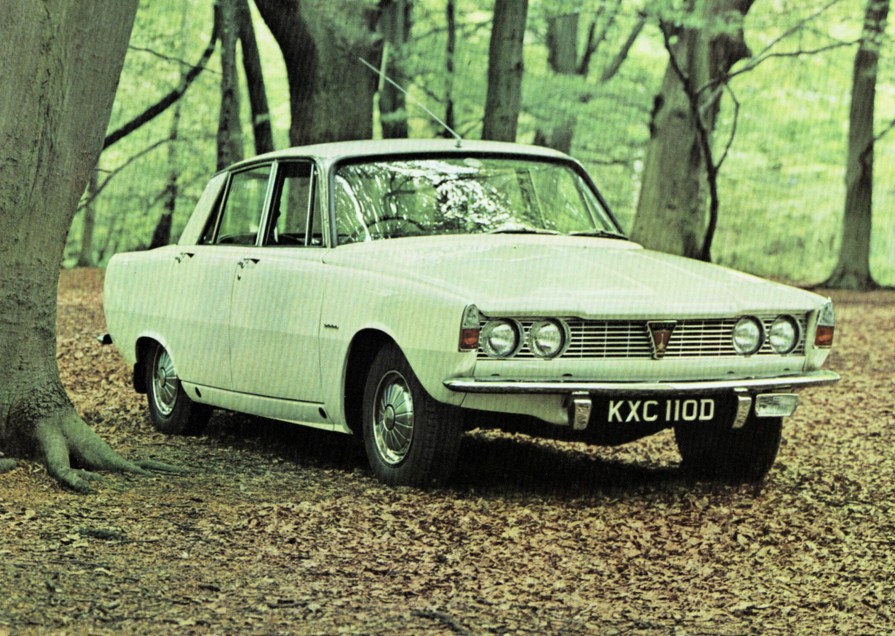
Introduced in 1963, the stylish 2000 was a complete break with tradition (the P4 was still available). It had a monocoque base with bolt-on body panels. The OHC engine was completely new. Automatic and twin-caburettor models arrived in 1967.
1967 Rover 20001967 Rover 2000Rover P6 2000 TC
1967 Rover 2000 Apart from minor detail changes like rear light style, wheel trims and badge design the P6 remained unchanged until the facelift in 1970/1. Post-1971 models are identified by re-styled black plastic radiator grille, new bonnet with bulges and wheel trim. The quarter panels were covered in black vinyl, sills were painted satin black unless a brown vinyl roof was fitted, in this case both the quarter panels and sills were brown. The Rover emblem was also moved to the bonnet. The 2200 of 1974 had a larger engine.
Rover ‘RV8’ engine
The ex-Buick 3500 engine was shoehorned into the P6 to become the Rover Three Thousand Five. Initially it was only available with Borg Warner automatic transmission. The 3500S, announced in 1971, was equipped with a 4-speed all synchromesh gearbox. 1974 cars were fitted with sundym windows and vinyl roofs.
This was Rover”s first monocoque model. It acquired front disc brakes in 1960. The Mark 2 arrived in 1962. The Coupé version was introduced at the same time.
Rover introduced the 3.5 litre, known as the P5B, in 1967. As with the 3 litre, it was available both as Saloon or Coupe. The P5 (3 Litre) had an option of a manual or automatic gearbox. The P5B (3.5 Litre) was only available as an automatic.
The differences between the two models are: wheels, chrome Rostyles on the P5B, straight side moulding as opposed to a sharp angle on the P5, no hole in the front grille for the starting handle, rubber strips on the over-riders and recessed fog lamps in the front wings on the P5B
1967 Rover P5 3.5 litre CoupéLuxurious interior
Between 1959 and 1973 Rover produced almost 70,000 P5s.
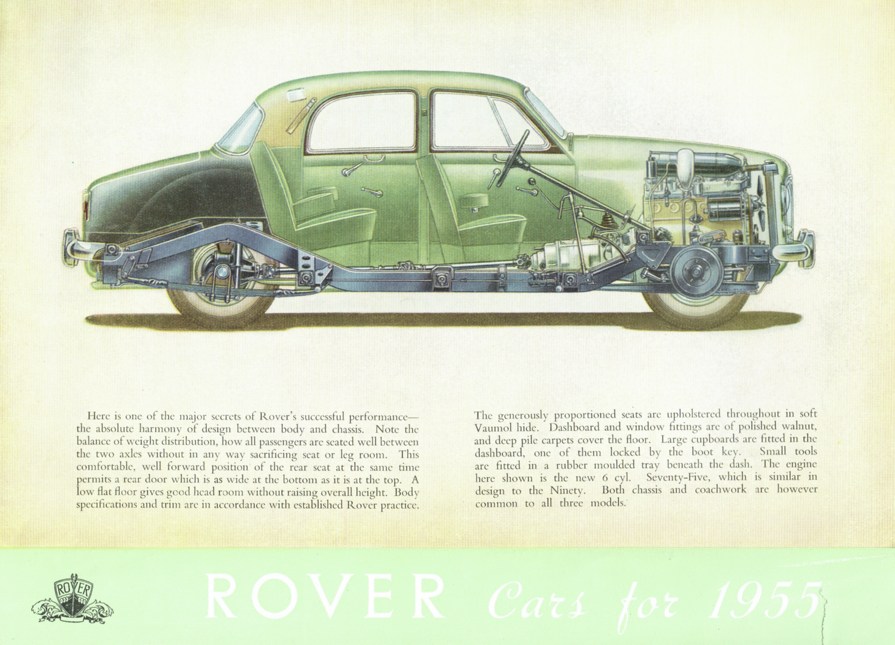
The P4 was based on a design for Studebaker by Raymond Loewy, famous for his streamline shapes. It was announced in the Autumn of 1949. Although the body was completely new, much of the chassis was P3. The P4 75 had the traditional Rover 3-lamp configuration at the front, which earned the car the nickname of Cyclops. The engine was basically the P3 2103 cc six-cylinder in-line unit, but now fitted with an aluminium cylinder head. The P4 model appeared in the course of the years as the 60, 75, 80, 90, 95, 100, 105, 105R, 105S, and 110.
1949 Rover 75 Cyclops
The Cyclops feature was dropped in 1952, mainly as it was found to cause serious cooling problems.
The Peugeot 404 came out in May 1960. Like its predecessor the 404 was designed by Pininfarina. Its angular styling was similar to that of the BMC A55 and Fiat 1800.
In all, Peugeot manufactured 2,779,926 404s. It was available in a number of body styles, including a coupé, cabriolet, break (station wagon), familiale (7-seater) and numerous commercial vehicle versions.
Production lasted until 1975 in Europe. It continued to be produced in Kenya until 1991!
404
1961 Peugeot 404
Specification 1971 Peugeot 404 76 hp Engine 1618 cc 4-cylinder Power 72 hp @5400 rpm Transmission 4 speed manual Chassis Unitary Suspension Independent front, rigid rear Brakes Disc brakes front, drum brakes rear Top speed 148 Acceleration 0-100 km/h 17,8 sec Dimensions LxWxH 4,45×1,62×1,45 m
The Peugeot 403 was designed by Pininfarina and was much roomier than the 203. The engine, a 1468 cc unit, produced 58 hp. It was available as a saloon, a cabriolet (the car Lieutenant Columbo drives in the TV series) and as a ‘break’.
A very advanced design for its time, the Peugeot 204 was introduced in 1965.
204
1971 Peugeot 204
Specification 1971 Peugeot 204 Engine 1130 cc 4-cylinder Power 60 hp @ 5750 rpm Transmission 4-speed manual Chassis Unitary Suspension Independent front and rear Brakes Disc brakes (front) drum brakes (rear) Top speed 140 km/h Acceleration 0-100 km/h in 18.5 sec Dimensions LxWxH 3,99×1,57×1,40 m